
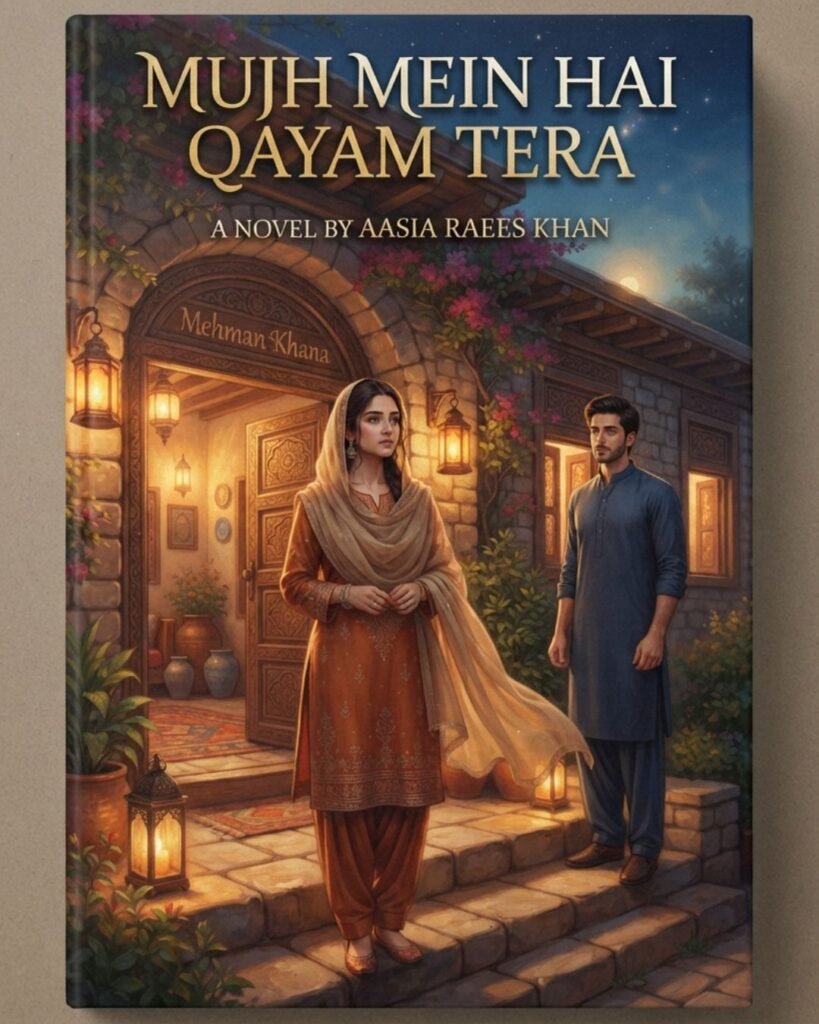
Read a detailed review of the full story, main characters, plot, themes, and ending of Mujh Mein Hai Qayam Tera by Aasia Raees Khan.
Summary of Mujh Mein Hai Qayam Tera:
Mujh Mein Hai Qayam Tera is an emotional family drama by Aasia Raees Khan revolving around a disputed inheritance, a guest house business, and the long path from betrayal to forgiveness. At its heart is the bond between Aani and Hadi, whose relationship is tested by old family wounds, a scheming relative named Masood, and a criminal network led by Yaqoob. The story explores how love and patience can eventually restore a broken family.
Characters:
- Aani – Aani is the central female character of the novel, a strong and self-reliant woman who becomes entangled in her family’s property disputes and the guest house business left behind by her elders. Her calm nature and quiet resilience carry her through betrayal and loss, and her growing closeness with Hadi becomes the emotional core of the story.
- Hadi – Hadi is the male lead, a composed and principled man who steps into Aani’s life at a turning point. He supports her through the guest house affairs and the family conflict, and his patience and sincerity slowly change Aani’s guarded outlook toward trust and love.
Supporting Characters:
- Masood – Masood is a manipulative relative whose greed over the inherited property and business drives much of the conflict in the story. His scheming and dishonesty repeatedly threaten Aani’s peace and stability.
- Yaqoob – Yaqoob heads a criminal network involved in fraud and exploitation, and his path crosses with the family’s affairs, adding danger and tension to the unfolding events.
- Jabbar Bhai and Afroz – Jabbar Bhai and Afroz are close family associates who stand by Aani and Hadi during difficult times, helping manage the guest house and offering emotional support through the family’s ups and downs.
Plot Overview:
The story opens around a family-owned rest house and a modest guest house business that becomes the center of dispute after the passing of the family’s elders. What should have been a source of stability instead exposes old resentments, as relatives disagree over rightful ownership, and the practical burden of running the property is left to the younger generation. Aani finds herself pulled into decisions far bigger than she expected, forced to balance grief with the everyday demands of keeping the business afloat.
Hadi enters this uncertain situation as someone connected to the family’s circle, and his steady involvement in the guest house affairs gradually earns Aani’s trust. Where others see only profit or loss in the property, Hadi sees the people affected by every decision, and this difference in perspective slowly draws him and Aani closer. Their interactions, at first purely practical, begin to carry an unspoken warmth that neither is quick to name.
Masood’s presence complicates matters considerably. Driven by personal gain, he manipulates family sentiment and legal technicalities to press his claim over the inherited property, showing little regard for the emotional toll his actions take on Aani and the household. His schemes force Aani and Hadi into a defensive position, and the guest house itself becomes a battleground for competing loyalties and hidden motives.
Parallel to the family dispute, the shadow of Yaqoob’s criminal dealings looms over the story. His network’s fraudulent activities and pursuit of easy money intersect with the family’s world, adding a layer of real danger to what began as a domestic disagreement. Investigations, confrontations, and moments of narrow escape heighten the tension as the characters realize how deep the corruption around them runs.
As pressure mounts from both Masood’s scheming and Yaqoob’s criminal reach, Aani is repeatedly forced to choose between anger and restraint, between revenge and patience. Her relationship with Hadi becomes her anchor during this turmoil, offering her the emotional security she has long been missing, even as she struggles to fully open her heart after so much betrayal. Jabbar Bhai and Afroz stand firmly beside them, helping shoulder the practical and emotional weight of the crisis.
In the end, truth surfaces through patience rather than vengeance, and those responsible for exploiting the family’s trust are exposed and held accountable. Aani and Hadi’s relationship, tempered by hardship, matures into a lasting commitment, while the guest house that once symbolized conflict becomes a settled, hard-won achievement. The novel closes on the idea that justice, loyalty, and quiet endurance ultimately outlast greed and deception.
Themes:
- Family and Inheritance
- Love and Trust
- Betrayal
- Greed
- Justice
- Patience and Endurance
- Loyalty
- Forgiveness
- Crime and Corruption
- Emotional Security
- Perseverance
- Redemption
Conclusion:
Mujh Mein Hai Qayam Tera is the story of a family torn apart by greed and deceit, and slowly rebuilt through love and patience. Aasia Raees Khan uses Aani and Hadi’s journey to show how quiet strength can outlast betrayal, while Masood and Yaqoob’s schemes highlight the destructive pull of greed and corruption. The novel reminds readers that true security is found not in property or possession, but in trust, loyalty, and enduring love.
Tarz e Sitam Aur Tarah K Urdu Novel by Asia Raees Khan