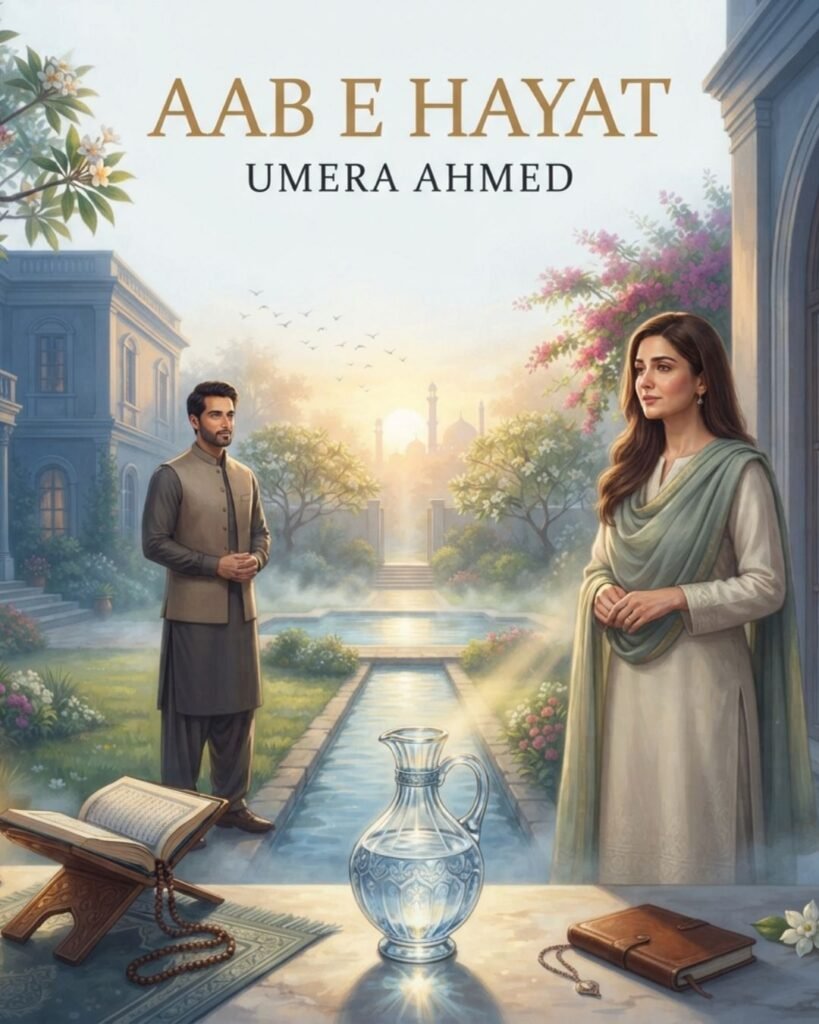
Aab e Hayat by Umera Ahmed continues Salar Sikander and Imama Hashim’s story from Peer-e-Kamil into married life, following how faith, parenthood, and financial ethics shape the family they build together. Read online or download the complete PDF.
Summary of Aab e Hayat:
Aab e Hayat begins as a continuation of Peer-e-Kamil, but its focus gradually expands from romance and spiritual transformation to the realities of adult life. Salar Sikander and Imama Hashim are now married, and their relationship is tested not by the same circumstances they faced before, but by the responsibilities that come with building a family. The novel explores how love changes when two people must share responsibilities, raise children, and make difficult decisions together.
Characters:
- Male Lead – Salar Sikander is the central male character of Aab e Hayat and one of the most recognizable characters from Umera Ahmed’s Peer-e-Kamil. In this sequel, he is portrayed as a transformed and more mature man whose extraordinary intelligence is accompanied by a stronger sense of faith and responsibility.
- Female Lead – Imama Hashim is the female lead and Salar’s wife. Her character continues the spiritual strength established in Peer-e-Kamil, but Aab e Hayat gives her a different kind of challenge: married life, motherhood, family responsibilities, and maintaining her values in everyday circumstances.
Supporting Characters:
- Jibraeel/Jibril Sikandar – Salar and Imama’s son. Available descriptions portray him as intelligent, responsible, and closely connected with his father’s ideas and aspirations. His upbringing becomes part of the novel’s larger discussion about the influence of parents on the next generation.
- Maheen – One of Salar and Imama’s children. Her presence contributes to the family-centered side of the story and the novel’s exploration of children’s upbringing and family relationships.
- Raeesa Sikandar – Described in available character summaries as Salar’s mother and a materialistic, worldly-minded member of the family. Her perspective provides contrast with Salar’s increasingly spiritual and principled outlook.
- Dawar Sikandar – Salar’s brother, described as ambitious, status-conscious, and more concerned with worldly interests. His character helps represent the conflict between material priorities and the values Salar attempts to follow.
- Raeesa – One source identifies Raeesa as an adopted daughter in Salar and Imama’s family. Her inclusion further develops the novel’s themes of parenting, family bonds, and raising children within a value-based household.
Plot Overview:
The story of Aab e Hayat begins after the events of Peer-e-Kamil, when Salar Sikander and Imama Hashim have moved into married life. Their relationship has passed beyond the stage of uncertainty and emotional struggle, but marriage brings a different set of responsibilities. The novel therefore focuses on the practical meaning of love, faith, patience, and companionship after two people have chosen to build a life together.
Salar’s transformation becomes one of the most important elements of the sequel. His extraordinary intelligence and professional abilities give him access to success, but his spiritual development makes him question whether worldly success alone has any lasting value. He becomes increasingly concerned with morality, justice, and the way financial systems affect society. His struggle with interest-based banking and his desire for a more ethical financial model form an important part of the narrative.
Imama’s role develops alongside Salar’s journey. She is no longer simply the woman at the center of his emotional transformation; she is his wife and the emotional foundation of their family. Her patience and faith help her navigate the pressures of domestic life and motherhood. Through Imama, the novel presents family life as a continuous process of sacrifice, understanding, and spiritual discipline rather than an idealized romantic ending.
As Salar and Imama become parents, the story expands to include the next generation. Their children, including Jibraeel/Jibril and Maheen, become part of the narrative, while Raeesa is described by one source as an adopted daughter. Parenting becomes a major concern because Salar and Imama want their children to succeed in the modern world without losing their moral and religious foundations.
The wider family also contributes to the novel’s social and intellectual conflicts. Characters such as Raeesa Sikandar and Dawar Sikandar represent perspectives more closely associated with worldly ambition, wealth, or status. Their contrasting attitudes allow the novel to examine materialism, family expectations, social pressure, and the difficulty of maintaining principles when practical life constantly demands compromise.
By the later stages of the story, Aab e Hayat has developed into much more than a continuation of a romantic relationship. It becomes a reflection on what happens after spiritual guidance: how people earn, spend, raise children, manage relationships, and respond to society while trying to remain faithful to their principles. The central journey of Salar and Imama therefore continues through family, responsibility, sacrifice, and the search for a meaningful life.
Themes:
- Faith and Spiritual Growth
- Marriage and Companionship
- Parenthood and Upbringing
- Materialism vs. Spirituality
- Halal Earnings and Financial Ethics
- Family Responsibilities
- Love and Sacrifice
- Moral Responsibility
- Generational Values
- True Success
Conclusion:
Aab e Hayat by Umera Ahmed is a continuation of Peer-e-Kamil that shifts the focus from the discovery of faith and love toward the responsibilities that follow them. Salar Sikander and Imama Hashim must now deal with marriage, children, career, finances, family relationships, and the pressures of modern society. The novel’s central message revolves around the idea that spiritual guidance is not the end of a person’s journey. It must influence everyday decisions, relationships, earning, parenting, and social responsibility. Through Salar and Imama’s family life, Umera Ahmed explores the continuing struggle between worldly demands and deeply held values.
For readers interested in spiritual Urdu novels, Islamic fiction, romantic Urdu novels, family stories, and character-driven narratives, Aab e Hayat offers a broader continuation of the world introduced in Peer-e-Kamil.
Ishq e Yaram Urdu Novel by Areej Shah