
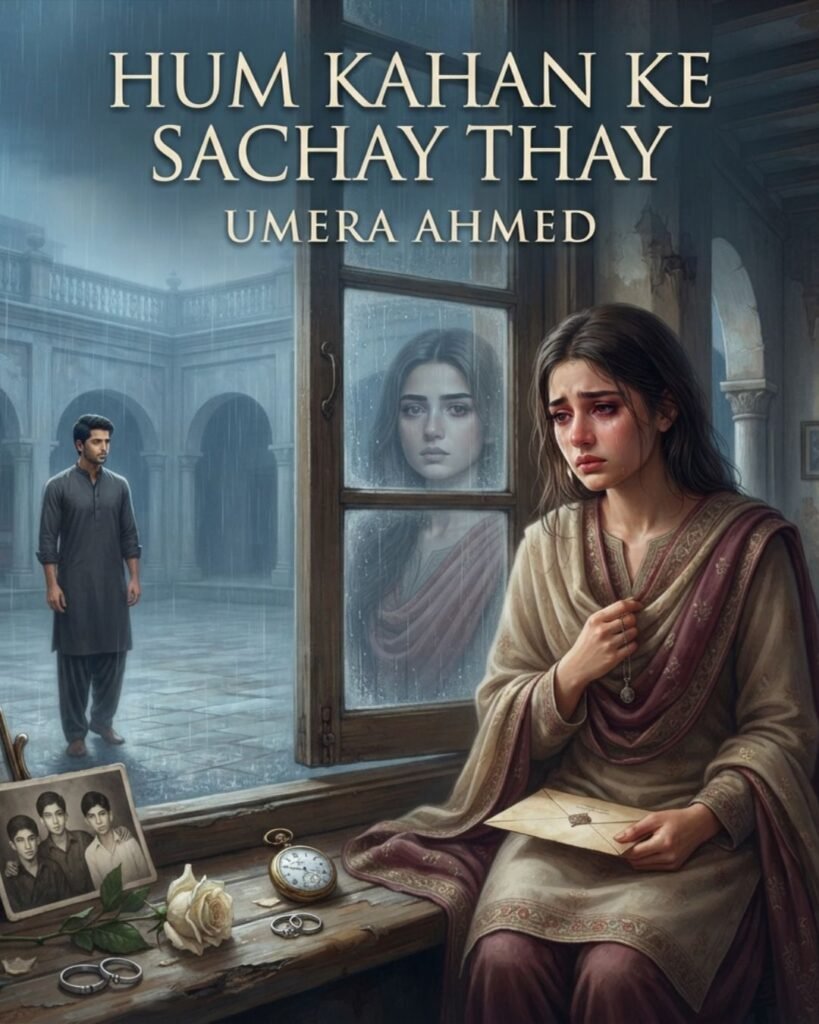
Read Hum Kahan Ke Sachay Thay by Umera Ahmed, an emotional Urdu novel about love, jealousy, family, trauma, and complex relationships.
Summary of Hum Kahan Ke Sachay Thay:
Hum Kahan Ke Sachay Thay Novel by Umera Ahmed is a powerful Urdu social-romantic novel that explores family dynamics, childhood relationships, jealousy, misunderstandings, emotional trauma, love, guilt, and forgiveness. The story revolves around three cousins,s Mehreen, Aswad, and Mashal, whose childhood friendship gradually becomes complicated as they grow older. The novel focuses strongly on human psychology and the destructive consequences of comparison, insecurity, assumptions, and family conflicts. Mehreen is intelligent and emotionally sensitive; Mashal struggles with jealousy and insecurity, while Aswad becomes caught between the two girls and the conflicting stories surrounding them.
Characters:
- Aswad Ayub – Aswad Ayub is one of the three central characters of Hum Kahan Ke Sachay Thay. He is Mehreen and Mashal’s cousin and shares a close childhood bond with both girls. He becomes an important figure in the emotional conflict between Mehreen and Mashal.
- Mehreen Mansoor – Mehreen Mansoor is the central female protagonist of the novel. She is intelligent, sensitive, academically successful, and artistically talented, but her difficult family background leaves her emotionally vulnerable.
Supporting Characters:
- Mashal Tahir – Mashal Tahir is Mehreen and Aswad’s cousin and one of the three central characters. She is beautiful, socially confident, and accustomed to receiving attention, but her mother’s constant comparisons between her and Mehreen create a deep sense of insecurity.
- Shagufta Tahir – Shagufta Tahir is Mashal’s mother and Tahir’s wife. She plays an important role in shaping Mashal’s insecurity because she repeatedly compares her daughter with Mehreen.
- Tahir Hafeez – Tahir Hafeez is Mashal’s father, Shagufta’s husband, and a close family member within the extended family. He is also the brother of Rabia and Saleha.
- Saleha Ayub – Saleha Ayub is Aswad’s mother and an important source of support for Mehreen. She is the sister of Rabia and Tahir and understands Mehreen’s difficult circumstances more deeply than many other family members.
- Rabia Nauman – Rabia Nauman is Mehreen’s mother. She is initially married to Mansoor but eventually leaves him because of his drug addiction and the instability surrounding their marriage. She later remarries, leaving Mehreen in the care of other family members.
- Rabia’s decisions have a major impact on Mehreen’s childhood and emotional development.
- Mansoor Ali – Mansoor Ali is Mehreen’s father and Rabia’s husband. His struggle with drug addiction and the breakdown of his marriage have a devastating impact on Mehreen. His death becomes one of the major traumatic events in her childhood.
Plot Overview:
The story begins with three cousins, Mehreen, Mashal, and Aswad,d growing up together. During childhood, the three share a close relationship, but their different personalities and family circumstances gradually begin to shape their relationships. Aswad is close to both girls, while Mehreen and Mashal initially share a friendship that later becomes increasingly complicated.
Mehreen’s family problems become a major turning point in her life. Her father, Mansoor, struggles with drug addiction and financial problems, while hher mother er Rabia, eventually leaves him. Mansoor’s death leaves Mehreen without the emotional security she once had. She subsequently grows up in an environment where she often feels unwanted and isolated.
As the cousins grow older, their emotional relationships become more complicated. Mehreen has secretly loved Aswad since childhood, while Mashal also wants his attention and eventually expresses her feelings to him. Aswad’s decisions and perceptions become influenced by the conflict between the two girls, allowing misunderstandings to grow.
The greatest tragedy occurs when Mashal dies, and Mehreen becomes the subject of suspicion. Aswad believes that Mehreen is responsible for Mashal’s death and allows his anger and grief to influence his treatment of her. The resulting emotional pressure causes Mehreen tremendous suffering. The story uses this conflict to explore how dangerous assumptions can become when people believe they understand a situation without knowing the entire truth.
The truth eventually changes everything. Shabbo reveals what she knows about the night Mashal died, and Aswad discovers evidence that contradicts everything he had believed about Mehreen. He realizes that he misunderstood her and deeply regrets the way he treated her. After Aswad apologizes and asks for forgiveness, Mehreen eventually forgives him, and their relationship moves toward reconciliation and a new beginning.
Themes:
- Family Dynamics
- Jealousy
- Childhood Trauma
- Misunderstanding
- Emotional Abuse
- Guilt and Regret
- Loneliness
- Female Rivalry
- Human Psychology
- Truth and Perception
- Emotional Manipulation
- Sacrifice
- Redemption
- Self-Worth
- Consequences of Assumptions
- Healing and Reconciliation
Conclusion:
Hum Kahan Ke Sachay Thay Novel by Umera Ahmed is a deeply emotional Urdu social-romantic story built around Mehreen, Aswad, and Mashal, three cousins whose childhood relationship is gradually transformed by jealousy, family pressure, misunderstanding, love, and loss. The title Hum Kahan Ke Sachay Thay reflects the novel’s deeper question about human nature. The story does not simply divide its characters into completely innocent or completely guilty people; instead, it examines how circumstances, insecurity, family influence, jealousy, love, and mistakes can shape human behavior. This psychological complexity is one of the central strengths of Umera Ahmed’s storytelling.
For readers interested in Urdu social novels, emotional romance, psychological fiction, family dramas, tragic relationships, jealousy-based stories, and character-driven narratives, Hum Kahan Ke Sachay Thay remains an important work by Umera Ahmed.
Tashnagi e Yaar Urdu Novel by Alishey Khan