
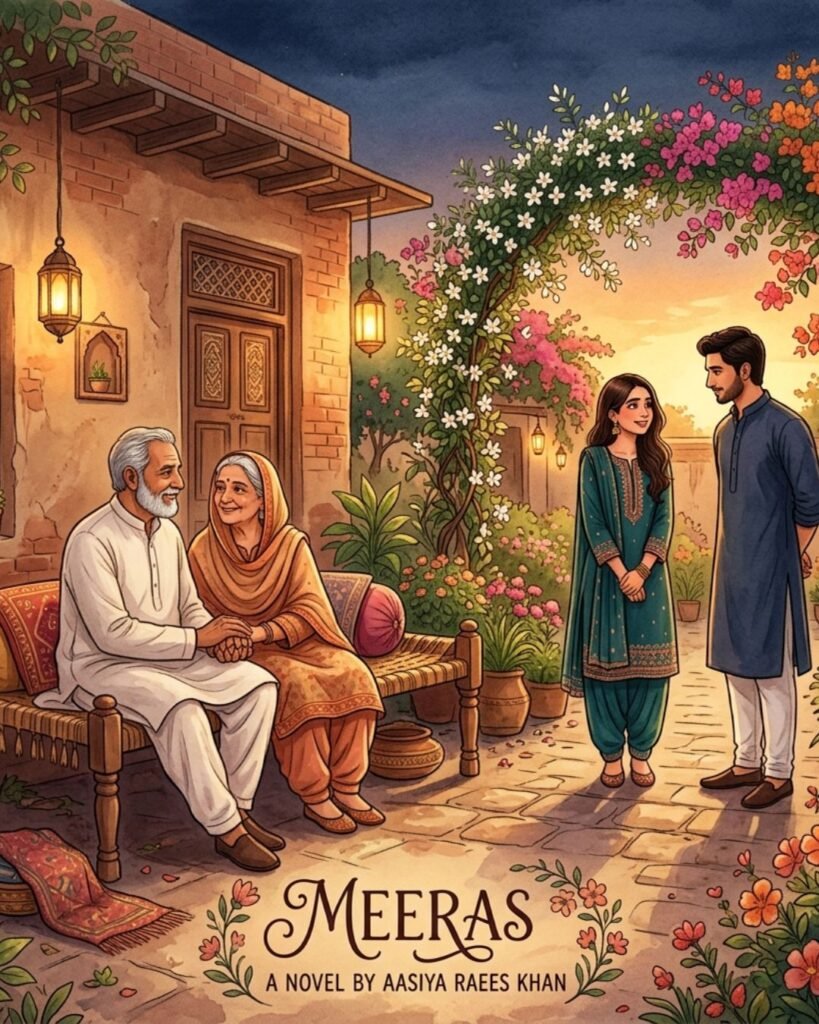
A detailed review of Meeras, a family and romantic drama by Aasiya Raees Khan, published in Khawateen Digest, July 2023, covering the summary, main characters, plot, themes, and ending.
Summary of Meeras:
Meeras is a multi-generational family drama that explores how the unresolved conflicts, broken marriages, and buried grudges of one generation shape the choices and relationships of the next. At the center of the story is Tasadduq Hussain, a man whose own troubled past with his parents and his failed marriage cast a long shadow over his children and grandchildren. As the younger generation, including Ahsan, Sitara, and Nemaa, grows up caught between old family disputes and new feelings of love, the novel asks whether inheritance is only about property, or whether pain, resentment, and even the capacity for forgiveness can be passed down as well.
Characters:
- Tasadduq Hussain – The patriarch whose difficult childhood, broken family, and strained relationship with his own parents form the emotional root of the story. His past decisions and regrets directly affect the fate of his children.
- Sitara (Tara) – A young woman deeply affected by her parents’ separation, carrying anger and mistrust toward her father, Tasadduq Hussain. Her emotional journey toward acceptance and love is central to the novel.
- Ahsan – A sincere and steady young man who falls in love with Sitara. His patience and quiet determination gradually help soften the family’s old wounds and resistance to their relationship.
Supporting Characters:
- Nemaa – A young woman connected to the family whose own path toward love and marriage is complicated by inherited family tensions and expectations.
- Dada Jaan and Dadi Jaan (Grandparents) – The elder authority figures of the family who eventually try to mediate between the generations, urging reconciliation and taking responsibility for past mistakes.
- Iffat – A woman within the family circle whose choices and relationships mirror the novel’s larger themes of love, duty, and self-respect.
- Fozia Aunty and the extended family circle – Relatives who raised the cousins together in childhood, and whose home and gatherings remain the emotional backdrop against which the adult conflicts of the story unfold.
Plot Overview:
Meera opens by tracing the childhood of a group of cousins raised together under the care of an aunt, whose home became the center of their laughter, quarrels, and shared memories. Among this closely knit group, small emotional bonds begin to form early, though as children, none of them fully understand the weight of what they are feeling. These carefree years, spent over tea gatherings, family visits, and childhood mischief, quietly plant the seeds of relationships that will later prove far more complicated than anyone imagined.
As the cousins grow older, the story shifts to the older generation and reveals the source of the family’s deep unrest: Tasadduq Hussain’s own painful history with his parents and his failed marriage. His regrets, his estrangement from his children, and the bitterness that formed between him and his family become the inheritance that the younger generation must now confront, whether they want to or not. Sitara, his daughter, grows up carrying resentment toward her father because of the separation and its lasting effects on her mother and siblings.
Into this tense atmosphere enters Ahsan, whose feelings for Sitara grow steady and sincere despite the friction surrounding her family. His attempts to reach her are met with hesitation, suspicion, and outright resistance, not because Sitara doubts her own heart, but because she cannot separate love from the pain her family’s history has taught her to expect. Around them, the older relatives, including the grandparents, attempt to intervene, torn between old loyalties and a growing recognition that the family’s silence and unresolved anger have done more harm than good.
Parallel to this, Nemaa’s own story unfolds with similar obstacles, as her path toward love and marriage becomes tangled with family expectations, old disagreements, and the unspoken rule that the past must not be spoken of directly. Difficult conversations begin to surface: confrontations between Tasadduq Hussain and his own parents, painful admissions of guilt, and long-postponed apologies that neither erase the past nor fully resolve it, but begin to open a path forward.
As tensions reach their peak, the family is forced into a reckoning during a medical emergency and a series of emotional confrontations that finally bring long-hidden truths into the open. Tasadduq Hussain is compelled to face the consequences of his choices, while Sitara and Ahsan must decide whether they are willing to build a future together despite everything that stands behind them. The grandparents, too, are pushed to acknowledge their own role in the family’s fractures, offering long-overdue words of accountability.
By the novel’s final chapters, forgiveness begins to replace resentment, not completely or easily, but enough for the family to move forward. Sitara and Ahsan’s relationship becomes a symbol of hope rising out of inherited pain, while Tasadduq Hussain and his parents make tentative steps toward reconciliation. Aasia Raees Khan closes the story on the idea that true inheritance is not only what is left behind in property or grudges, but also the choice each generation makes about whether to carry pain forward or set it down.
Themes:
- Inheritance and Legacy
- Family Conflict
- Forgiveness
- Love and Patience
- Parental Mistakes
- Generational Trauma
- Reconciliation
- Duty and Self-Respect
- Marriage and Family Expectations
- Regret and Redemption
- Sibling and Cousin Bonds
- Emotional Healing
Conclusion:
Meeras is a story about how the past never truly stays in the past; it lingers in silences, in strained relationships, and in the fears children inherit from their parents’ mistakes. Through Tasadduq Hussain’s long-delayed reckoning with his own family, and through Sitara and Ahsan’s determined love, Aasia Raees Khan builds a narrative that is as much about generational healing as it is about romance. The novel reminds readers that true inheritance lies not in what is left unspoken, but in the courage to forgive, to apologize, and to choose a different path for the next generation.
Mohabbat Aik Paheli Urdu Novel by Aasia Raees Khan

One Comment