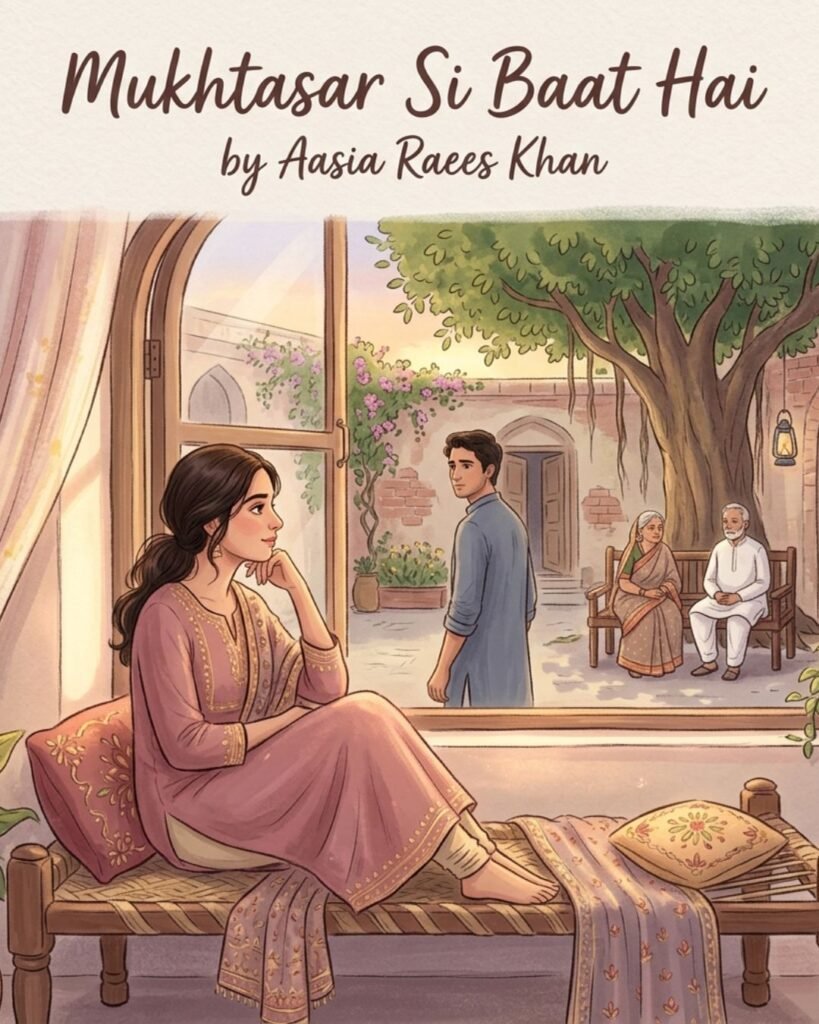
A detailed review of Mukhtasar Si Baat Hai by Aasia Raees Khan, published in Khawateen Digest in November 2023, covering the summary, main characters, plot, themes, and ending.
Summary of Mukhtasar Si Baat Hai:
Mukhtasar Si Baat Hai is a story of trust, doubt, and the quiet strength of family bonds, centered on Qoot and her complicated relationship with Ansar, whose suspicion and hesitation repeatedly threaten a connection that both of them secretly want to protect. Around them, a wider circle of relatives, including Aqeela, Aalia, Najam Ahsan, and Dadi and Dada Jaan, become entangled in questions of marriage, loyalty, and family honor. The novel explores how misunderstanding and mistrust, if left unchecked, can quietly poison relationships, while patience, honesty, and faith slowly find a way to mend what suspicion has broken.
Characters:
- Qoot (also called Quwwat) – The central female character of the story, calm and dignified despite being repeatedly doubted and misjudged by those close to her. Her patience and quiet resilience in the face of suspicion and unfair accusations form the emotional core of the novel.
- Ansar – A conflicted young man whose deep-seated distrust and insecurity repeatedly place a strain on his relationship with Qoot. His journey through doubt, jealousy, and eventual self-reflection drives much of the story’s tension.
Supporting Characters:
- Aqeela – A senior family figure who plays a guiding and sometimes disciplining role in family matters, often trying to steer the younger generation toward reconciliation and better understanding.
- Aalia – A close relative whose presence weaves through key family gatherings and decisions, often acting as a bridge between different sides of the family.
- Najam Ahsan – A family member whose own opinions and reactions add further complexity to the unfolding disputes over marriage and trust within the family.
- Dadi Jaan and Dada Jaan (Grandparents) – The elder authority figures of the household, whose blessings, disapproval, and eventual involvement carry significant weight in resolving the younger generation’s conflicts.
- Ibad and other relatives – Extended family and cousins whose comments, suspicions, and interventions frequently complicate the central relationship, reflecting how deeply personal matters become tangled in collective family opinion.
Plot Overview:
Mukhtasar Si Baat Hai opens within a household where family expectations, old customs, and generational authority weigh heavily on the younger members, particularly on Qoot, whose composed nature is often mistaken for indifference. As marriage discussions begin to surface within the family, questions of compatibility, character, and trust immediately come into focus, with Aqeela and the elder generation playing key roles in shaping the direction these decisions take.
At the heart of the story lies Ansar, whose growing feelings for Qoot are constantly undercut by his own insecurities and suspicion. Rather than communicating openly, he allows doubt to fester, misinterpreting Qoot’s words and actions in ways that repeatedly create distance between them. Qoot, for her part, is left to navigate not only Ansar’s mistrust but also the judgment of relatives who are quick to speculate and slow to extend the benefit of the doubt.
As the family gathers for various occasions, the tension between the two only deepens, with accusations, misplaced jealousy, and unresolved grievances surfacing in moments that should otherwise be joyful. Other relatives, including Aalia and Najam Ahsan, become drawn into these disputes, sometimes attempting to mediate and other times inadvertently deepening the rift through gossip or assumption. Beneath the surface, a pattern emerges: nearly every conflict in the story traces back to unspoken doubts rather than any real wrongdoing.
Midway through the novel, external pressures begin to test the family further, forcing individuals to confront their own biases and behavior. Qoot, though hurt by the repeated accusations against her character, refuses to let bitterness define her, choosing instead to remain steady and dignified. Meanwhile, Ansar’s continued inner conflict becomes harder to ignore, as those around him, including his own family, begin questioning whether his suspicion is protecting him or simply destroying what could have been a strong, loving relationship.
As the story moves toward its climax, long-overdue conversations begin to take place. Confessions of jealousy, fear, and misplaced pride surface, and both Ansar and the wider family are forced to reckon with how much damage unchecked mistrust has caused. Dadi Jaan and Dada Jaan, along with Aqeela, become instrumental in pushing the younger generation toward honesty, urging them to set aside ego and finally address the matters that have kept them apart for so long.
By the final chapters, understanding begins to replace suspicion, and the truth that was always simple, a mukhtasar si baat, a small and short matter, is finally acknowledged by those who had complicated it with fear and pride. Ansar’s realization of his own faults and Qoot’s unwavering patience allow the relationship to move toward reconciliation, while the family as a whole is left with a deeper appreciation for honesty, trust, and the importance of communication over assumption.
Themes:
- Trust and Suspicion
- Family Honor
- Patience and Dignity
- Miscommunication
- Jealousy and Insecurity
- Reconciliation
- Marriage and Family Expectations
- Self-Reflection
- Faith and Gratitude
- Forgiveness
- Generational Wisdom
- Loyalty
Conclusion:
Mukhtasar Si Baat Hai is, at its heart, a story about how the smallest misunderstandings, when fed by pride and silence, can grow into the largest obstacles between two people who genuinely care for each other. Through Qoot’s quiet strength and Ansar’s difficult journey toward self-awareness, Aasia Raees Khan crafts a narrative about the cost of suspicion and the healing power of honesty. The novel closes on the reminder that most of what divides families and lovers is, in truth, a small matter, one that only grows large when left unspoken.
Hyper Metro Pia Urdu Novel by Aasia Raees Khan